Swedish Genealogy News, Nr. 3


Riksarkivet Restores U.S. Access to Swedish Archival Databases


Researchers in the United States can once again access the online search tools of the Swedish National Archives, Riksarkivet, following the completion of a major system maintenance effort in late February 2026.

The restoration of access quickly became welcome news across the Swedish American genealogical community, where many researchers rely on Riksarkivet’s extensive digital collections to trace family histories. For several months, users outside Sweden experienced difficulties reaching the archive’s databases and images.

According to Riksarkivet, the temporary disruption was the result of a large-scale maintenance project designed to improve both the stability and security of its digital services. Software engineers spent the final week of February upgrading core systems and implementing new safeguards intended to prevent automated scraping and other misuse of the site’s data.

As part of the update, the archive has added a simple Captcha verification step to confirm that users are human rather than automated programs. The additional step—typically required only once per research session—is intended to reduce spam activity and automated extraction of records while keeping the databases broadly accessible to legitimate researchers.

Despite the added security measure, the process for locating parish records remains largely unchanged.

How to Access Records in the Digital Research Room


Researchers can begin their search from the Riksarkivet homepage:

  1. Select “Explore archives and collections”, then choose “Search the collections.”
  2. In the search interface, enter the name of the parish in the “Archive/parish” field on the left side of the screen and click Search. Alternatively, users may go directly to the Digital Research Room and enter the name of the parish under the heading Sök arkiv.
  3. A Captcha prompt will appear asking users to verify that they are human. Check the box labeled “I’m not a robot.” This step is generally required only once per session.
  4. After verification, the name of the parish will appear next to the word “kyrkoarkiv” (parish archive), marked with a small monitor icon—for example, Dunkers kyrkoarkiv. Click the link.
  5. A list of available record types within the parish archive will appear on the left side of the screen. Select a record series, such as AI Husförhörslängder (household examination records).
  6. Choose the relevant volume by clicking the green “Bild” (image) icon next to the volume covering the desired years.
  7. The image viewer will open, allowing users to navigate the digitized pages and search for individuals within the records.


Searching Through National Archives Database (NAD)


Another path to the records is through Riksarkivet’s online catalog, the Nationell Arkivdatabas (NAD).

Researchers can search by entering the name of a parish or other administrative jurisdiction in the “Sök arkiv” field. After running the search, locate the parish archive link—similar to the kyrkoarkiv entry described above—and proceed to the digitized records from there.


For genealogists with Swedish roots, the restored access marks the return of one of the most important online resources for Swedish family history research. The new security measures, while adding a small extra step, are designed to ensure the long-term stability and availability of the archive’s extensive digital collections.


Swedish Genealogy News, Nr. 2


RootsTech 2026: Spotlight on

Essential Databases for Swedish and Finnish Research

SALT LAKE CITY — The first morning of RootsTech 2026 began early for hundreds of eager genealogists, as about 200 attendees gathered at 8:00 a.m. MT for a session led by Swedish genealogy specialist Geoffrey Fröberg Morris. His presentation, Essential Databases for Swedish and Finnish Research, introduced researchers to key digital resources for tracing family lines in Sweden and Finland.

The class, sponsored by FamilySearch, was not broadcast or recorded during the conference session, but interest was strong despite the early start on the event’s opening day. Morris structured the presentation around the class handout, guiding participants through what he described as the most effective databases available for Swedish and Finnish genealogical research.

For Swedish research, Morris highlighted several major platforms, including ArkivDigital, Riksarkivet (the Swedish National Archives), FamilySearch, Ancestry, and MyHeritage. He also pointed attendees to several specialized resources valuable for local or targeted research. Among them were DISByt, the Stockholm City Archives databases, historical newspapers from the National Library of Sweden (Kungliga biblioteket), and Sweden’s Central Soldier Register.

Turning to Finland, Morris introduced attendees to the newly updated website of the National Archives of Finland, including its research interface, Astia. Additional resources covered included Finnish census and pre-confirmation records available through MyHeritage, FamilySearch, and Ancestry, as well as databases maintained by the Finland’s Family History Association.

Audience participation was a highlight of the session. Attendees posed a steady stream of questions throughout the presentation, leading to a lively and informative discussion about research strategies and database strengths.

Registration remains open for RootsTech 2026, which offers hundreds of recorded classes available through the conference website. Registration for RootsTech 2026 is available for free at RootsTech Registration. Morris’s presentation is expected to be recorded at a later date and added to the conference’s online library for those who were unable to attend the live session.

The class syllabus for Essential Databases for Swedish and Finnish Research is available at: Essential Databases for Swedish and Finnish Research.

Swedish Genealogy News, Nr. 1

Riksarkivet Not Accessible from United States

For years, historians and family researchers in the United States have used the Digital Research Room of Riksarkivet, the Swedish National Archives. The online portal provides access to a vast collection of parish registers, censuses, estate inventories, and other primary records essential to tracing Swedish ancestry.

Sometime in late 2025 — likely November or December — that access abruptly disappeared for American users.

Instead of the familiar search interface, visitors encountered a simple and frustrating browser notice: “This site can’t be reached.” The outage quickly became a topic of conversation across genealogy forums and social media groups, where researchers began comparing notes and asking the same question: What happened to Riksarkivet?

I contacted the archives directly by email to ask whether they were aware of the problem and if access from the United States might soon be restored. A representative confirmed that the digital publishing team knows about the issue. However, no timetable has been provided. Software engineers are working on a solution, but the archives could not say when American users will again have direct access.

In the meantime, researchers have been sharing a workaround.

Several U.S.–based genealogists report that the site can still be reached by using a virtual private network (VPN) or a browser extension that changes the user’s apparent geographic location. By connecting through another country — commonly Denmark, Norway, or Finland — the digital research room becomes accessible again.

Setting up the workaround is straightforward: create an account with a VPN provider, activate the connection, select a Nordic country as the server location, and then visit the Riksarkivet website. Under those conditions, the database loads normally.

Numerous services offer this capability, including ExpressVPN, NordVPN, IPVanish, and Proton VPN among others. Some free versions are available, though they often have limited features or slower connections. Many researchers instead opt for low-cost monthly subscription.

For now, the VPN solution has allowed researchers to continue their work, but it is clearly a temporary measure. Researchers on both sides of the Atlantic are hoping the technical team at Riksarkivet will soon restore normal international access to one of the most important resources for Swedish family history.

Two New Resources from the Federation of Swedish Genealogical Societies

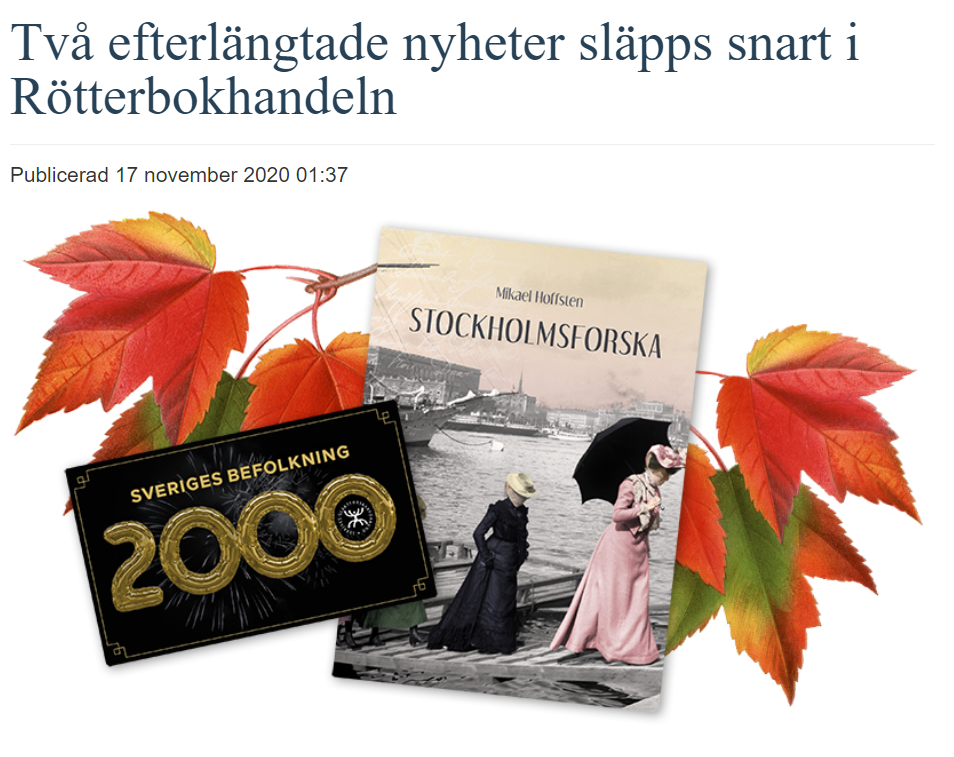
The Federation of Swedish Genealogical Societies (Sveriges Släktforskarförbund) announced 2 fantastic resources will be available through their online bookstore on Nov. 25, 2020. The 1st is the Sweden 2000 Census (Sveriges befolkning). This database will contain everyone who was registered in a Swedish parish at the end of 2000, almost 8.9 million people. Perhaps your wondering how they can publish the 2000 census? It’s because the privacy laws in Sweden are focused on protecting sensitive information and a persons name and address are not deemed sensitive. The 2nd is a new book called Stockholmsforska (in Swedish) that will be focused on the records and strategies for research in Stockholm City. For more information see https://www.rotter.se/senaste-nytt/3409-tva-efterlangtade-nyheter-slapps-snart-i-rotterbokhandeln